Adding Fractions With Unlike Denominators
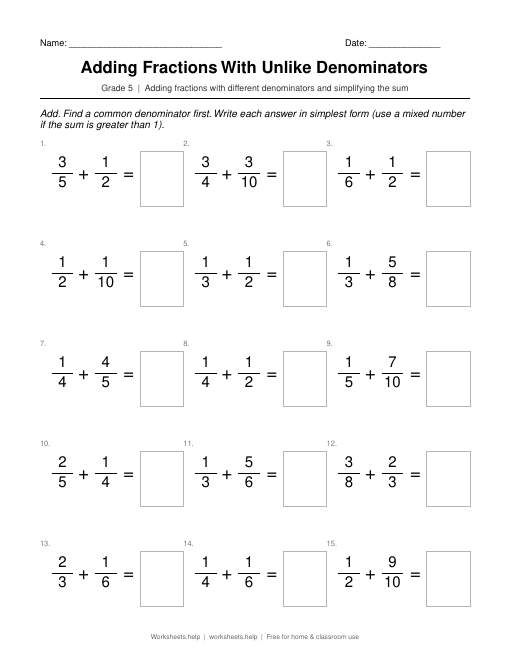
Skill: Adding fractions with different denominators and simplifying the sum
Download PDF worksheetAnswer key (PDF)
Free for personal and classroom use. Print at 100% / "Actual size" on US Letter paper.
About this worksheet
Adding fractions with different denominators is one of the major skills of fifth grade. This worksheet gives fifteen problems such as 2/3 + 1/4, where the denominators are different and students must find a common denominator before adding. Every fraction in the problems is already in simplest form, and the denominators come from 2, 3, 4, 5, 6, 8, 10, and 12, with common denominators no larger than 24, so the focus stays on the method rather than on big numbers.
Students write each answer in simplest form, using a mixed number when the sum is greater than 1. Some sums simplify, which gives practice with that step too.
How to use it: remind students why a common denominator is needed. Fractions can only be added directly when the pieces are the same size, just as you can add 3 apples and 2 apples but not 3 apples and 2 oranges. To find a common denominator, list multiples of each denominator and look for the smallest one they share. For 2/3 + 1/4, multiples of 3 and 4 meet at 12, so 2/3 = 8/12 and 1/4 = 3/12, and the sum is 11/12.
The answer key gives every sum in simplest form. An unsimplified but equivalent answer shows correct adding, so review simplifying separately if needed. This worksheet supports Common Core standard 5.NF.A.1 (add and subtract fractions with unlike denominators, including mixed numbers, by replacing given fractions with equivalent fractions that have like denominators).
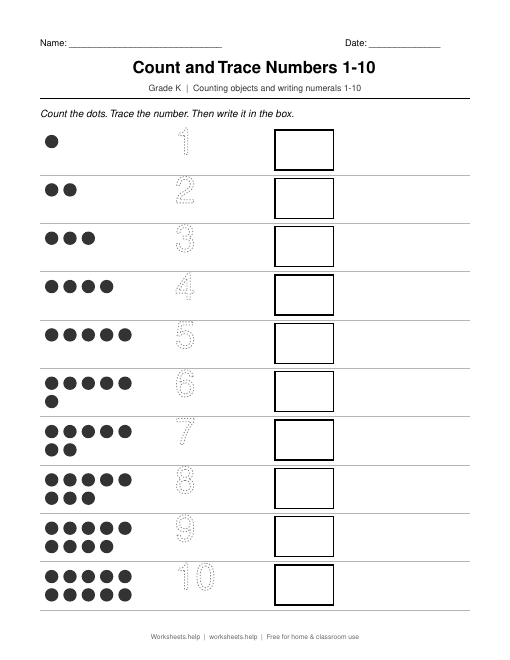 Count and Trace Numbers 1-10
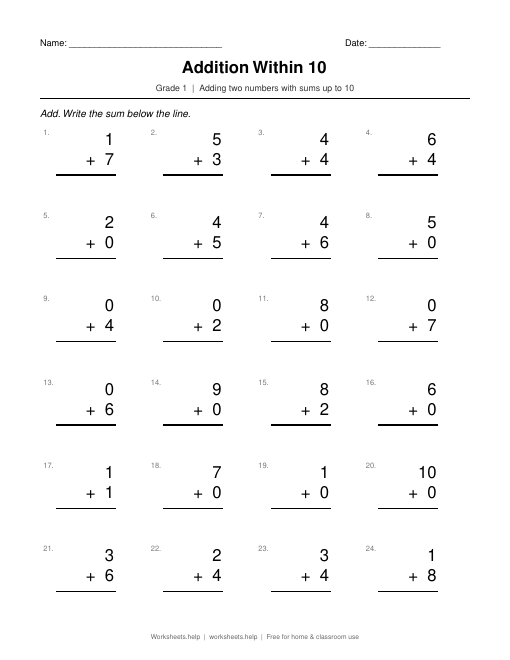 Addition Within 10
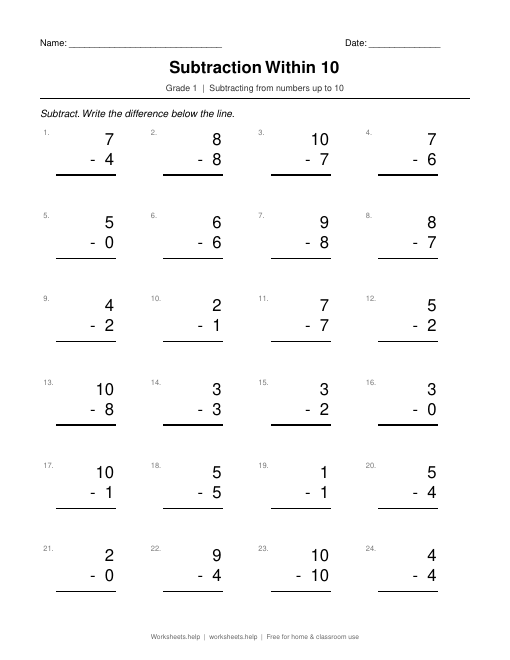 Subtraction Within 10